

Table of Contents
- Why Miniature Scale Matters at the Table
- What Miniature Scale Actually Means
- Heroic vs True Scale Miniatures: What's the Difference?
- Standard D&D Miniature Base Sizes Explained
- Matching Scale to Your Game System and Table
- Scaling 3D Models for Tabletop Play
- Conclusion: Picking the Right Miniature Scale
- Frequently Asked Questions
Last Updated: October 3, 2026
Why Miniature Scale Matters at the Table
A miniature that's 20% too tall throws off line of sight, cover rules, and the visual logic of your whole encounter. That's the practical reason scale matters, and it's why working out how to choose D&D miniature scale before you buy anything saves you money and table arguments later. At Borishotch Industries, we print miniatures for players and Dungeon Masters every week.
There's a second reason, and most guides skip it entirely.
Scale isn't just about size. It's about compatibility. A 32mm heroic figure standing next to a 28mm true-scale fighter doesn't look like a taller character, it looks like a printing error. Get the benchmark right at the start and everything else, bases, terrain, storage, falls into place.
Below, we break down what the numbers actually mean, how base sizes work, and how to match a scale to your table before you spend a penny.
What Miniature Scale Actually Means
Miniature scale is the ratio between a model's height and the height of the real creature it represents, expressed in millimetres from foot to eye level. A "28mm scale" miniature isn't 28mm tall. It's a human-sized figure whose eye line sits roughly 28mm above the base.
That distinction trips up almost every newcomer. The measurement is a benchmark, not a total height, and manufacturers apply it loosely.
The 28mm and 32mm Benchmarks
The 28mm figure has been the hobby's default human reference for decades. A 32mm miniature uses the same reference point but stretches proportions slightly, giving a bulkier, more dramatic silhouette. Neither is "correct". They're conventions, and mixing them on one table is where things get messy.
How Scale Is Measured
Most manufacturers measure from the base to the eyes, not the top of the head. That's why a 28mm dwarf and a 28mm elf can look wildly different in total height. The dwarf is stocky, the elf is tall, but both hit the same eye line.
Heroic vs True Scale Miniatures: What's the Difference?
Heroic scale miniatures exaggerate head, hand, and weapon size so details read clearly from across a table. True scale miniatures use realistic human proportions, which look more natural up close but can appear thin and flat at gaming distance.
The trade-off is visibility versus realism. Heroic scale wins for gameplay. True scale wins for display pieces and dioramas.
If you're painting for a shelf, true scale rewards the effort. If you're pushing models around a grid and calling out attacks, heroic scale is the practical pick. Most tabletop ranges sit somewhere in the middle, leaning heroic.
Standard D&D Miniature Base Sizes Explained
Base size is separate from figure scale, and it's fixed by creature size category rather than by how tall the model is. A Medium creature uses a 25mm round base regardless of whether the miniature is heroic or true scale.
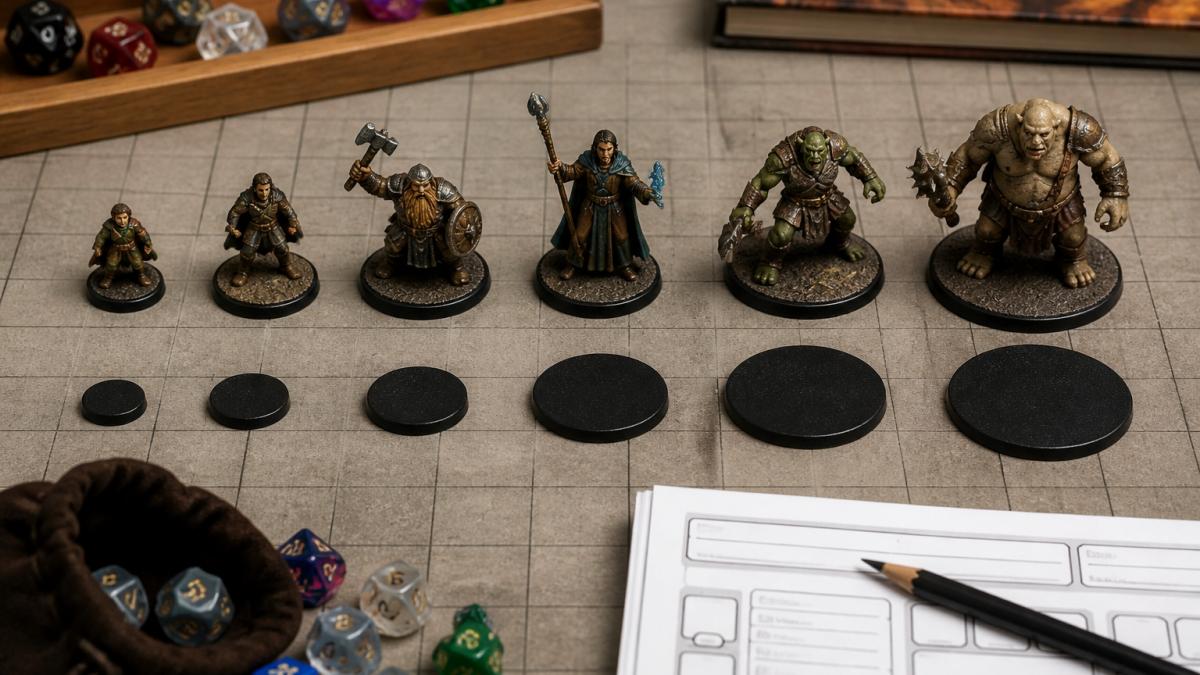
| Creature Size | Base Diameter | Typical Use |
|---|---|---|
| Tiny | 12mm | Familiars, sprites |
| Small/Medium | 25mm | Most player characters, goblins |
| Large | 50mm | Ogres, dire wolves |
| Huge | 75mm | Giants, young dragons |
| Gargantuan | 100mm+ | Ancient dragons |
The key point: a figure's height and its base size are two independent decisions. You can have a tall heroic miniature on a standard 25mm base, and that's perfectly legal at the table.
Matching Scale to Your Game System and Table
Match scale to your game system first, then to your table space. Rulesets assume a base size, and terrain is built to a height convention. Break either and your scenery stops working.
Three things decide it:
- Game system: Check what the rules and official ranges use. Most fantasy tabletop games standardise on 28mm or 32mm heroic.
- Table space: Larger scales need larger terrain, which eats into your play area. A 32mm range on a small kitchen table gets cramped fast.
- Detail level: Bigger models hold more detail and are easier to paint. Smaller models let you field more figures in the same footprint.
If you're building a collection from scratch, pick one scale and stay with it. Consistency beats perfection every time.
Scaling 3D Models for Tabletop Play
Scaling 3D models for tabletop play means adjusting the model in your slicer so the printed figure hits your target eye-line height, then checking that the base still matches your creature size category. Get the order wrong and you'll rescale the base along with the figure.
Here's the sequence we'd use:
- Measure a reference miniature you already own, base to eye line
- Open the model in your slicer and note its current height
- Calculate the multiplier: target height divided by current height
- Apply the multiplier to the figure only, not the base
- Verify the base diameter against your creature size table
- Print a test piece before committing to a full set
Conclusion: Picking the Right Miniature Scale
Scale is a compatibility decision, not an aesthetic one. Pick your benchmark, match your bases to creature size, and keep the whole collection consistent. Do that and every future purchase slots straight into your existing setup.
Borishotch Industries prints D&D miniatures, dice towers, and articulated models across a range of scales, with automatic volume discounts and free postage on qualifying orders. If you're kitting out a campaign and want pieces that match what you already own, tell us your scale and we'll point you to the right range. Get started with Borishotch Industries and build a table that looks like it belongs together.
Frequently Asked Questions
What is the standard scale for D&D miniatures?
Most D&D miniatures sit at 28mm to 32mm scale, measured from the base to roughly eye level. Official ranges tend toward the larger end, while many third-party and 3D printed models sit around 28mm. Either works on a standard 25mm grid, so pick one and stay consistent across your collection rather than mixing sizes within a single warband.
Does 28mm scale mean the same as 32mm scale?
No. A 28mm figure is noticeably shorter and slimmer than a 32mm one, even though both fit the same grid. The difference shows up most in bulk, since a 32mm miniature takes up more visual space on the table. If your existing collection is 28mm, adding 32mm heroes will make them look oversized next to the rest.
How do I ensure my 3D printed miniatures match my existing collection?
Measure a few figures you already own from base to eye level, then note the base diameter. When scaling 3D models for tabletop play, set the model height to match that measurement before printing, and check the base fits your grid. Printing one test piece first saves you from reprinting an entire set at the wrong size.
Can I mix different miniature scales on the same tabletop?
You can, but it rarely looks right. A 32mm ogre standing beside a 28mm fighter reads as a size mismatch rather than a genuine size difference. If you want variety, keep one scale for the whole collection and use larger base sizes, not larger figures, to show that a creature is bigger.