

Last Updated: 2 November 2026
Quick Summary
Custom 3D printed gaming accessories are worth the money when the theme, fit and durability suit how you play. A dice tower at £30.00 or a few well-chosen miniatures gives strong everyday value, so start with the piece that matches your campaign's setting.
- Choose a dice tower on theme first, since it sits in the middle of the table for hours.
- All five dice towers are priced at £30.00 and arrive unpainted.
- Free postage applies on UK orders over £50.
- Volume discounts run at 5% off £50, 10% off £100 and 15% off £150.
- PETG is tougher and more heat-resistant than PLA, suiting items that get knocked about.
Table of Contents
- What Counts as a Custom 3D Printed Gaming Accessory?
- Dice Towers Compared: Keeper of the Ruins, Wizard, Kraken, Dwarven and Orc
- Custom 3D-Printed Miniatures for Your Campaign
- 3D-Printed Board Game Accessories and Tabletop Organisation
- 3D-Printed Gaming Tokens and Practical Use at the Table
- Durability, Material and Print Quality: What to Check Before You Buy
- Booking Your Next Campaign Kit From Borishotch Industries
- Frequently Asked Questions
Custom 3D printed gaming accessories can be a smart buy for the right table, but whether they are worth the money depends on what you want them to do. At Borishotch Industries, we make a range of dice towers, miniatures and busts, and this guide walks through how to judge them on fit, price, durability and delivery. We focus on the Keeper of the Ruins, Wizard, Kraken, Dwarven and Orc dice towers, all priced at £30.00, so you can see where each one earns its place.
What Counts as a Custom 3D Printed Gaming Accessory?
A custom 3D printed gaming accessory is a physical item made by layering plastic or resin into a shape designed for play, storage or display. Dice towers, miniatures and token holders are the most common examples.
Think about how the item will be used before you buy. A dice tower gets handled every session, while a miniature may sit on a shelf for years. Those two uses demand different things from the print.
Dice Towers Compared: Keeper of the Ruins, Wizard, Kraken, Dwarven and Orc
We sell five dice towers, and each one takes a different approach to the same job. All five are priced at £30.00 and arrive unpainted, so the price covers the print and nothing more. Painting is a separate hobby decision you can make later.
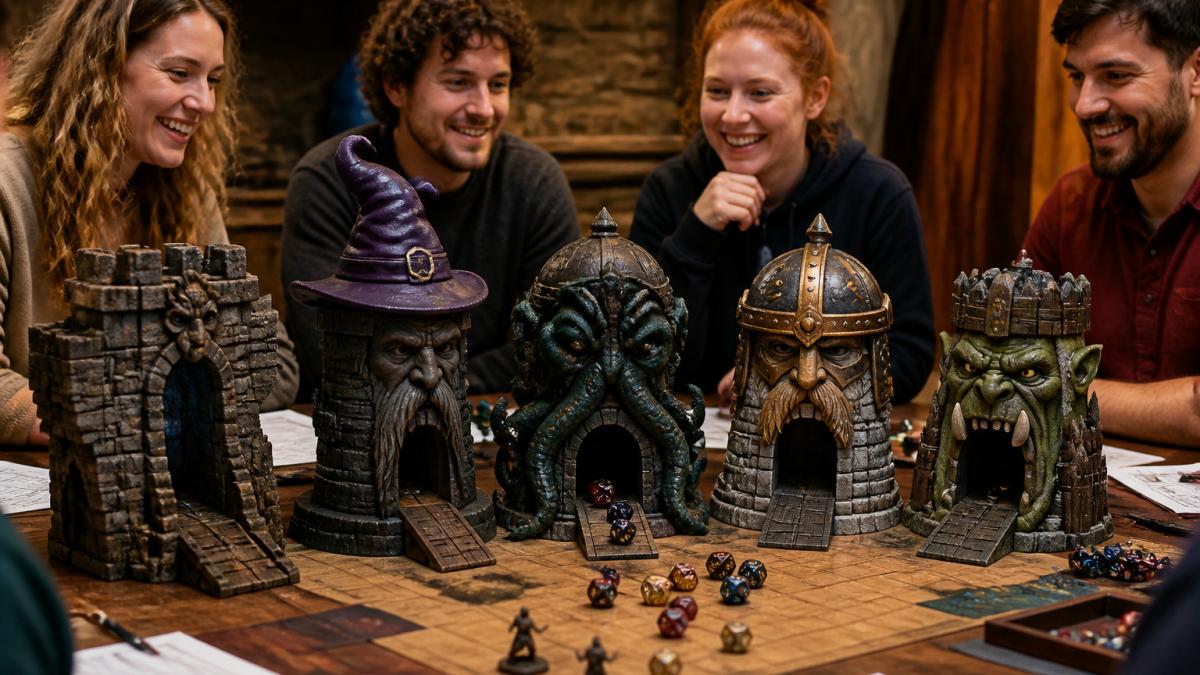
The Keeper of the Ruins tower is built around a sphinx guardian, which suits campaigns with riddles and puzzles. The Wizard tower draws on a cryptic tower filled with roots and weeds, a good fit for mysterious or arcane tables.
Thematic Fit and Table Presence
Choose on theme first. A dice tower sits in the middle of the table for hours, so its look matters as much as its function. If your campaign has a clear setting, pick the tower that matches it.
Size and weight also affect table presence. Check the listing details before you buy, because a tall tower needs more clear space than a compact one.
Price, Postage and Free Delivery Thresholds
At £30.00 each, the five towers sit at the same price, so price alone will not separate them. The deciding factors are theme and how many you need. Free postage applies on UK orders over £50, so buying two towers at £30.00 each (£60.00) qualifies for free delivery without any extra spend.
Our volume-based discounts also reward larger baskets: 5% off at £50, 10% off at £100 and 15% off at £150. If you are buying a tower alongside miniatures, the discount can bring a mixed order down noticeably.
You can view the Keeper of the Ruins tower on its product page, and compare the Kraken tower on its listing before deciding.


Custom 3D-Printed Miniatures for Your Campaign
Miniatures are where custom prints earn their keep for many Dungeon Masters.
Print quality decides whether a miniature looks good on the table. Look for clean surfaces and sharp detail in the product photos, and check whether the piece arrives unpainted.
You can browse a Dungeons & Dragons Kraken miniature to see the level of detail, or look at the Apprentice Wizard miniature for a character piece.
3D-Printed Board Game Accessories and Tabletop Organisation
Board game accessories are where 3D printing quietly earns its keep. Loose components slow setup, cause mid-game frustration and increase the chance of losing a token under the sofa. A printed organiser, token tray or storage insert solves that by giving every piece a home. The table below compares the main accessory types so you can judge which one suits your table before you spend anything.
| Accessory type | Main use | Customisation options | Typical print time | Difficulty | Best for |
|---|---|---|---|---|---|
| Box insert / organiser | Sorting components inside the game box | Compartment layout, lid fit, label recesses | Long (multi-part) | Moderate | Games with many small components |
| Token tray | Holding counters during play | Diameter, depth, number of wells | Short | Low | Status markers and resource tracking |
| Card holder / stand | Keeping hands and draw piles tidy | Angle, capacity, card size | Short to moderate | Low | Card-heavy games |
| Dice tray | Containing rolls and protecting the table | Size, wall height, felt recess | Moderate | Low | Any dice-based game |
| Player dashboard | Holding tokens, cards and a miniature per player | Layout, player count, name plate | Moderate to long | Moderate | Campaign and legacy games |
Fit, Tolerance and the Measurements That Matter
The practical test is fit, and fit is decided in millimetres. Measure the internal dimensions of your game box, the footprint of the largest component and the height of the tallest stack. A printed insert that is even a few millimetres out will rattle, refuse to seat or stop the lid closing flush. Build in a small clearance on every sliding part, because printed parts are rarely perfectly to nominal size.
Keeper of the Ruins Dice Tower →
Licensing and Commercial-Use Rights for Downloaded Models
If you download a model rather than commission a design, check the licence before you print. Model licences commonly fall into a few bands: personal use only, personal use with modification allowed, and commercial use with or without attribution. A personal-use licence normally rules out selling printed copies, and many also restrict sharing the file itself. If you intend to print organisers to sell at a club or market, look specifically for a commercial licence and keep a record of the terms.
A Realistic Cost and Time Estimate
A printed organiser is rarely free once you count everything. Filament for a multi-part insert is a real cost, and failed prints, support material, electricity and post-processing all add to it. A common pattern is that a large multi-part insert takes several hours of machine time and may need one or two reprints to get tolerances right. Before committing, add up the filament, the electricity and your own time, then compare that total against simply buying a purpose-made insert.
If you would rather buy a finished piece than print your own, our dice towers and miniatures show the level of finish you can expect from a commissioned print.
3D-Printed Gaming Tokens and Practical Use at the Table
Custom tokens are a useful, low-cost upgrade for campaigns that rely on markers, status counters or resource tracking. They are small, so the print needs to be crisp enough that symbols and numbers stay readable.
Consider how often tokens will be handled. Tokens that get shuffled and stacked every session need a sturdier finish than ones used once in a while. Thicker prints generally hold up better to repeated handling.
Durability, Material and Print Quality: What to Check Before You Buy
Durability is the difference between an accessory that survives a campaign and one that fails in the first month. Before you buy any custom print, check four things: the material, the layer finish, the wall thickness and the handling you expect. A dice tower that is dropped or knocked will show weak points quickly, so solid walls and a stable base matter more than surface decoration.
Materials and Where Each One Suits
Most custom gaming accessories are printed in one of a few common materials, and each has a different balance of strength, heat resistance and finish.
- PLA is the most common choice for display pieces and light-handling accessories. It prints crisply and holds fine detail well, but it softens at relatively low temperatures, so it is a poor choice for anything left in a hot car or near a radiator.
- PETG is tougher and more heat-resistant than PLA, which makes it a better fit for dice towers, stands and anything that gets knocked about. It is slightly less crisp on fine detail.
- Resin gives the sharpest detail and is the usual choice for miniatures and finely detailed tokens. It is more brittle than filament prints, so thin protruding parts need care.
Ask what material is used and whether the piece is intended for handling or display. Check the product listing for any stated finish or specification, and do not assume a particular material unless it is written there.
Load-Bearing Parts and Design Considerations
Not every part of an accessory carries the same load. A headphone stand or controller holder has to support weight at the top, so the joint between the upright and the base is the weak point. A dice tower has to survive repeated knocks at the base and around the collection tray. Look for designs that thicken these areas, use a wide base for stability and avoid long unsupported overhangs.
Safety Around Heat and Electronics
Accessories that sit near electronics or heat sources deserve extra thought. A stand placed next to a monitor, console or radiator will run warmer than one on a cool desk, and a material that softens at low temperature can sag over time. Keep printed accessories away from direct heat, and avoid placing them where they will be exposed to sustained warmth. For anything that holds a device, check that the contact points will not scratch or trap heat.
Print Quality in the Photos
Print quality shows in the surface. Look for even layers, clean edges and crisp detail in the product photos. Where a listing is vague, ask before you buy. If you are unsure whether a print will suit heavy use, choose a sturdier design or a shelf-only piece.
Booking Your Next Campaign Kit From Borishotch Industries
Custom 3D printed gaming accessories are worth the money when the theme, fit and durability suit how you play. For most tables, a single well-chosen dice tower at £30.00 or a few carefully picked miniatures gives a strong return on everyday use. Start with the piece that matches your campaign's setting, then add more as your table grows.
Browse the full range at Borishotch Industries, and when your basket passes £50, free UK postage applies and volume discounts stack on larger orders.
Frequently Asked Questions
What gaming accessories can be 3D printed?
Dice towers, miniatures, monster figures, token sets and desk organisers are among the most common 3D printed gaming accessories. Borishotch Industries currently offers five themed dice towers at £30.00 each, supplied unpainted, so buyers can paint them to suit their table. Other accessories depend on what is available in the range, so check each product page for its features and description before ordering.
Are 3D-printed accessories suitable for tabletop games?
Yes, provided the piece is designed for the job it will do. A dice tower needs a stable base and enough internal structure to keep dice rolling cleanly, while a miniature should hold fine detail without snapping at thin points. Most players use 3D printed pieces for scenery, dice and tokens rather than for anything that needs to take heavy handling, so it is worth considering how the piece will be used at the table.
Can you customise 3D-printed gaming accessories?
Customisation depends on the product. Borishotch Industries' dice towers arrive unpainted, which gives owners room to add their own colours and finishes. For bespoke requests beyond the listed range, contact the team before ordering to confirm what can be produced. Describe the theme, the size you need and any deadlines so you know what is realistic before committing.
What should I check before buying a 3D-printed miniature?
Check whether the piece arrives painted or unpainted, how large it is in relation to your other figures, and whether the listing describes its features clearly. Compare the price with postage, since delivery can add noticeably to the total on a single item. Borishotch Industries offers free postage on UK orders over £50 and automatic volume discounts of 5% off £50, 10% off £100 and 15% off £150, so grouping items in one order often brings the cost per piece down.
