

Table of Contents
- What Makes the Best Tabletop Terrain for D&D Campaigns
- Creature Miniatures: Building Your Monster Collection
- D&D Dungeon Tiles: Creating Structured Encounters
- Modular Terrain for D&D: Flexibility Across Campaigns
- D&D Scatter Terrain: Environmental Detail and Atmosphere
- Quick Comparison: Which Terrain Type Suits Your Game
- Conclusion
- Frequently Asked Questions
Last Updated: 12 October 2026
What Makes the Best Tabletop Terrain for D&D Campaigns
When you're running a D&D campaign, the difference between a forgettable encounter and an unforgettable one often comes down to the quality of tabletop terrain D&D you use. At Borishotch Industries, we've watched countless Dungeon Masters transform their tables with the right miniatures and environmental pieces. The best tabletop terrain for dnd campaigns isn't about spending the most money, it's about choosing pieces that match your campaign's visual style and your players' engagement level.
Terrain serves three critical functions in tabletop gaming: it establishes atmosphere, clarifies spatial relationships during combat, and gives players something tangible to interact with. A well-chosen collection of miniatures and scatter terrain turns a blank battlemat into a living world. Your players will lean forward. They'll strategise differently. They'll remember that encounter for months.
The challenge most DMs face is knowing where to start. Should you invest in large creature miniatures first? Build out modular dungeon tiles? Layer in environmental scatter pieces? The answer depends on your campaign's scope, your players' preferences, and your budget. Below, we'll show you exactly how to evaluate each terrain type and build a collection that works for your table.
Creature Miniatures: Building Your Monster Collection
Monster miniatures are your foundation. Without them, your players are imagining an ankheg or a purple worm instead of seeing one. The difference is immediate and dramatic.
When you're building a creature collection, think in tiers. Small and medium threats form the backbone of most campaigns, the goblins, ettercaps, and earth elementals your party encounters regularly. Large and legendary creatures create the memorable moments: the owlbear that nearly killed the rogue, the purple worm that reshaped the campaign entirely.
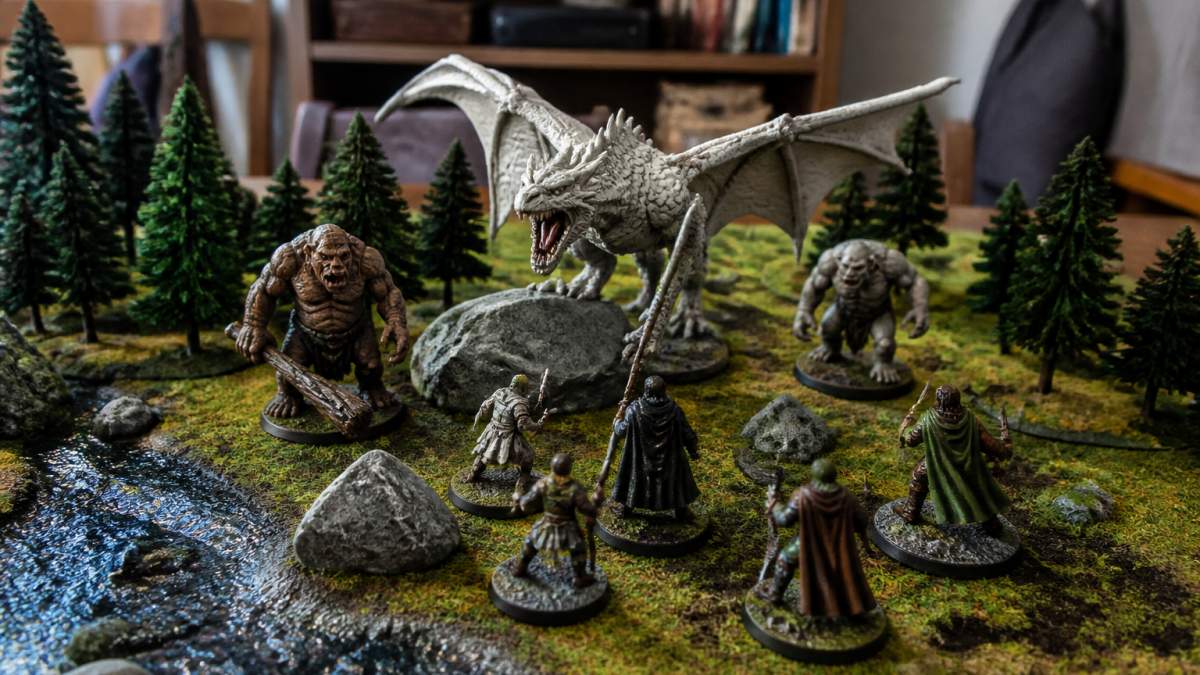
Small and Medium Threats
These are your workhorse miniatures. Goblin chiefs, ettercaps, ankhegs, creatures your party fights regularly. Quality here matters because your players see these pieces constantly.
The Dungeons & Dragons Goblin Chief Miniature at £4.00 is an excellent starting point. A goblin chief commands its troops with visible authority, and the detail on a 32mm resin model makes the difference between a token and a character your players want to defeat. For a small investment, you get a miniature detailed enough to anchor an entire goblin encampment encounter.
If your campaign ventures into forests or caves, the Dungeons & Dragons Ettercap Miniature at £4.00 delivers genuine menace. An ettercap's spider-humanoid hybrid form is unsettling on the battlemat in a way a drawn token never is. Pair it with a few smaller spider miniatures, and your ambush encounters become viscerally threatening.
For underground encounters, the Dungeons & Dragons Ankheg Miniature at £5.00 captures the creature's predatory nature perfectly. An ankheg bursting from beneath the earth is a classic D&D moment. A detailed miniature makes that moment land properly.
The Dungeons & Dragons Earth Elemental Miniature at £7.00 works equally well as a guardian creature or a summoned ally. Its solid, imposing form reads clearly from across the table, which matters during tense combat rounds.
Large and Legendary Encounters
These are the moments your players talk about. A large creature demands space, attention, and a miniature worthy of the occasion.
The Dungeons & Dragons Behir Miniature at £10.00 is a serpentine predator that dominates the battlemat. Its coiled posture and multiple legs make positioning matter tactically. Players instinctively back away when they see this piece.
For a campaign featuring nature corruption or druidic conflict, the Dungeons & Dragons Awakened Tree Miniature at £15.00 and Dungeons & Dragons Tree Blight Miniature at £15.00 create atmosphere instantly. An awakened tree as an ally or a twisted tree blight as an enemy shifts the entire encounter's tone. These pieces tell a story before combat even begins.


The Dungeons & Dragons Gulthias Blight Miniature at £20.00 is a campaign centrepiece. This corrupted, vampiric entity demands respect. It's the kind of miniature that makes players sit up straighter when you place it on the table.

For truly epic encounters, the Dungeons & Dragons Purple Worm Miniature at £30.00 is the apex predator. An 80-foot subterranean worm is a legendary threat. A detailed 32mm miniature of this creature transforms a high-level encounter into something genuinely terrifying.
D&D Dungeon Tiles: Creating Structured Encounters
Dungeon tiles give you a foundation for encounters without requiring a full terrain-building hobby. They're practical, modular, and let you focus on storytelling rather than construction.
The best dungeon tiles share two qualities: they're intuitive to assemble, and they're flexible enough to represent multiple environments. A stone tile set should work for a dungeon, a crypt, a fortress, or a collapsed ruin. You're not buying terrain for a single session, you're building a system.
Modular tiles solve a real problem. Your party decides to explore a side tunnel you didn't expect them to find. With tiles, you improvise quickly. Without them, you're describing the scene while players squint at a blank battlemat. The tiles do the work for you.
Consider starting with a core set of stone dungeon tiles, then expanding into thematic variants as your campaigns evolve. A forest tile set unlocks wilderness encounters. A cavern set opens up underground exploration. You're building flexibility into your table.
Dungeons & Dragons Awakened Tree Miniature →
Modular Terrain for D&D: Flexibility Across Campaigns
Modular terrain for tabletop terrain D&D is where serious DMs invest. These are the 3D-printed walls, doors, staircases, and architectural elements that transform a flat surface into a three-dimensional dungeon.
The advantage is obvious: you build once, use infinitely. A modular staircase works in a wizard's tower, a dwarven fortress, a dragon's lair, or an ancient temple. Your investment scales across campaigns.
The challenge is knowing where to start. Most DMs begin with basic wall sections and doorways, then add complexity, collapsed sections, trapped corridors, multi-level structures. You're building a modular dungeon kit over time, not buying everything at once.
Quality matters here more than anywhere else. That's why investing in high-quality 3D-printed pieces from the start saves money long-term. You won't need to replace them.
Borishotch Industries specialise in detailed 3D-printed miniatures and terrain pieces. When you're ready to expand into modular terrain, their collection of custom pieces allows you to build encounters that feel genuinely lived-in.
D&D Scatter Terrain: Environmental Detail and Atmosphere
Scatter terrain is the final layer. These are the small pieces that transform a scene from functional to immersive: barrels, crates, furniture, rubble, vegetation, magical effects.
A scattered handful of barrels in a warehouse encounter changes how players approach the space. They see cover. They plan positioning. They imagine the scene. That's scatter terrain working.
The best scatter terrain is thematic and varied. A forest encounter needs fallen logs, boulders, and vegetation. A wizard's tower needs bookshelves, tables, and arcane debris. A graveyard needs tombstones, crosses, and twisted trees. You're building visual language.
Scatter terrain doesn't need to be expensive. Small 3D-printed pieces, painted or unpainted, create enormous atmosphere. Many DMs start with a handful of pieces and expand based on their campaign's needs. A crypt encounter? Add some sarcophagi. A tavern brawl? Scatter some tables and chairs.
The layering effect is cumulative. A creature miniature on a blank mat is functional. Add dungeon tiles and you have structure. Add scatter terrain and you have a world. Your players feel the difference immediately.
Quick Comparison: Which Terrain Type Suits Your Game
| Terrain Type | Best For | Investment Level | Setup Time | Flexibility |
|---|---|---|---|---|
| Creature Miniatures | Defining encounters, visual impact | Low to moderate | Minutes | High, reuse across campaigns |
| Dungeon Tiles | Structured dungeons, quick prep | Moderate | 5-10 minutes | Moderate, limited by tile sets |
| Modular Terrain | Complex environments, long campaigns | High | 15-30 minutes | Very high, endless customisation |
| Scatter Terrain | Atmosphere, environmental storytelling | Low | Variable | Very high, mix and match |
Most experienced DMs use all four types. You start with creature miniatures because they have the highest visual impact per pound spent. You add dungeon tiles for practical structure. You invest in modular terrain as your campaigns become more ambitious. You layer in scatter terrain as your budget and hobby time allow.
The question isn't which type to choose, it's which to prioritise first. If you're running combat-heavy campaigns with frequent encounters, creature miniatures deliver immediate value. If you're running exploration-focused games with intricate dungeons, modular terrain and tiles matter more. If you're focused on atmosphere and storytelling, scatter terrain amplifies everything else.
Conclusion
The best tabletop terrain for dnd campaigns matches your table's priorities and evolves with your campaigns. Start with creature miniatures, they deliver visual impact immediately and work across multiple campaigns. Add dungeon tiles for structure. Invest in modular terrain as your ambitions grow. Layer in scatter terrain to create immersive scenes.
Quality 3D-printed miniatures and terrain pieces from Borishotch Industries give you detailed, durable pieces that work session after session. Our specialised range of D&D miniatures and modular terrain components lets you build encounters that genuinely immerse your players. With free postage on UK orders over £50 and automatic volume discounts, you can build a complete terrain collection without breaking your budget. Start with a handful of creature miniatures and expand as your campaign unfolds.
Frequently Asked Questions
What terrain do you need for a D&D campaign?
The essentials depend on your campaign setting and encounter style. Most groups benefit from a mix of creature miniatures for combat encounters, dungeon tiles for structured indoor scenes, and scatter terrain for environmental detail. Start with pieces matching your current campaign theme, forest encounters need different elements than underground dungeons. Quality 3D printed miniatures like the Ankheg or Owlbear provide immediate visual impact, while modular tiles offer flexibility across multiple sessions.
What is the difference between D&D dungeon tiles and scatter terrain?
Dungeon tiles form the structural foundation of encounters, creating walls, floors, and room layouts that define movement and tactical positioning. Scatter terrain adds atmospheric detail within those spaces, trees, rocks, barrels, without dictating the map structure. Together, they create immersive scenes. Dungeon tiles work best for planned encounters with defined boundaries, whilst scatter terrain enriches any environment and adapts to improvised scenes.
Are modular terrain tiles worth using for D&D?
Yes, particularly for campaigns spanning multiple settings or sessions. Modular terrain for D&D saves preparation time and money by allowing you to reconfigure the same pieces for different encounters. Rather than purchasing terrain specific to each session, you build a flexible library of compatible pieces. This approach works well for Dungeon Masters managing long campaigns with varied locations, and it scales as your collection grows.
What terrain works best for dungeon encounters?
Dungeon encounters benefit from structured layouts using dungeon tiles to define corridors, chambers, and tactical spaces. Pair these with creature miniatures appropriate to your monster selection, a Purple Worm demands dramatic scale, whilst a Goblin Chief needs supporting minions. Add scatter terrain like rubble or pillars for cover and atmosphere. The combination creates encounters that feel purposeful rather than improvised, giving players clear tactical options.
Can the same tabletop terrain be used for multiple campaigns?
Absolutely. Quality modular terrain for D&D is designed for reuse across different campaigns and settings. Creature miniatures work in any campaign where that monster appears, an Owlbear encounters a party in a forest whether it's year one or year five of your world. Scatter terrain like trees and rocks adapts to multiple environments. This flexibility makes investing in quality pieces cost-effective over time, particularly if you run several campaigns or play with different groups.